Round One Is Keywords, Round Two Is Depth
Round one is a recruiter or an ATS matching terms: languages, frameworks, middleware, cloud services, domain vocabulary. It takes seconds, so keywords belong in obvious places—the skills block and the first clause of each project bullet.
Round two is an engineer reading line by line. They want to know the scale of the systems you touched, the bottlenecks you hit, why you chose one approach over another, and what changed. Participants-in-a-project phrasing fails here.
- Group the skills block: languages → frameworks → storage → tooling and infrastructure
- Put the technology keyword in the first eight words of a bullet
- Give every project at least one number: throughput, latency, cost, or coverage
Project Bullets That Carry Information
A high-signal project entry has five parts: business context and scale, the module you owned, the key technical choice and its reason, the hard part, and the measurable outcome. A bullet without an outcome reads as filler.
When there is no monitoring data, use verifiable substitutes: endpoint counts, load-test results, recovery time, review pass rate, or the share of the release cycle you removed. The number does not need to be impressive—it needs to survive questioning.
- Weak: Worked on the order module using Spring Boot and MySQL.
- Strong: Rebuilt the order lookup path with tiered caching and cursor pagination, cutting P99 from 820ms to 130ms across 3M daily calls.
- Weak: Participated in frontend performance work.
- Strong: Cut LCP from 3.4s to 1.6s with route-level splitting, lazy images, and font subsetting, lifting signup conversion 6%.
Where a Tech Stack Ends and Expertise Begins
Longer is not better. Twenty entries invite a random spot check you cannot pass. Use eight to twelve grouped items and put your two or three strongest first.
Expertise is a commitment: claim it and you should be able to discuss internals, edge cases, and production incidents. Most candidates are better served by proficient, reserving expert for the library you maintain or the runtime you have read.
- Languages: TypeScript, Go, Java—with years of use or a representative project
- Frameworks and middleware: React, Node.js, Spring Boot, gRPC, Kafka, Redis
- Storage: MySQL sharding, Elasticsearch, object storage
- Infrastructure: Docker, Kubernetes, CI/CD, cloud services
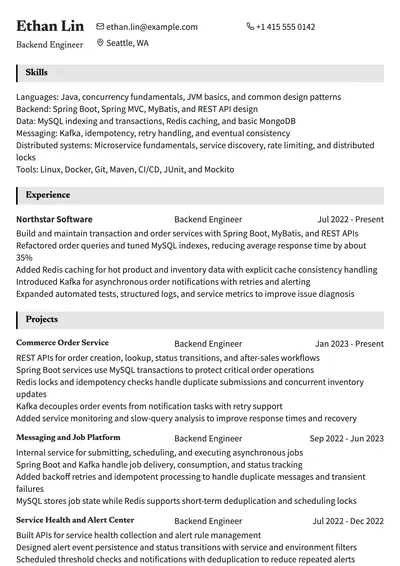 Left-Right Split Resume Template
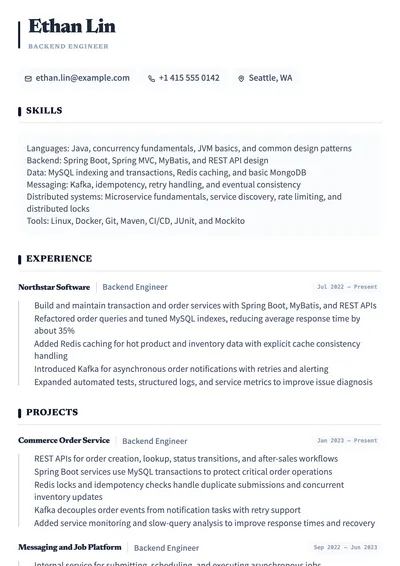 Swiss Grid Resume Template
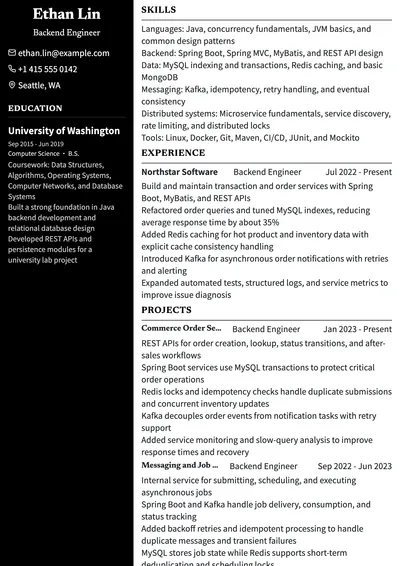 Modern Two-Column Resume Template